Clarksville, TN, has quietly become one of the most talked-about rental markets in the mid-South — and the data backs that up. Whether you’re relocating to the area, looking to rent your first apartment in Clarksville, or trying to understand where the market is headed, having accurate, up-to-date information makes a significant difference to your decision-making. This guide covers average rent in Clarksville across all property types and bedroom sizes, compares local prices to regional and national benchmarks, and unpacks the rental market trends shaping what renters can expect in 2026.
What Is the Average Rent in Clarksville, TN Right Now?
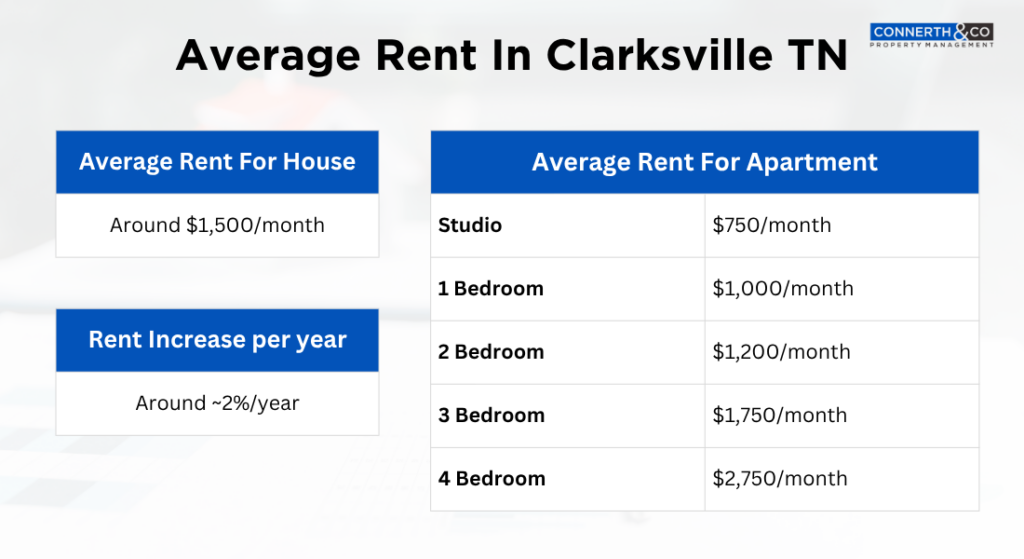
As of early 2026, the average rent for an apartment in Clarksville, TN, sits in the range of $750 to $2,750 per month, depending on property type, size, and neighborhood. This places Clarksville comfortably lower than the national average for comparable rental markets, making it one of the more affordable mid-sized cities in Tennessee for renters. The median rent across all unit types has remained relatively stable over the past twelve months, with modest increases compared to the previous year rather than the sharp upward movement seen in many other Sun Belt metro areas.
Rental statistics from listing platforms and local property data show that the Clarksville rental market has matured considerably since the rapid growth period of 2022 and 2023. After several years of above-average rent price increases driven by population growth and limited inventory, the market has found a more measured pace. For renters entering the market in 2025 and 2026, this means more options, slightly more negotiating power, and a rental landscape that rewards careful research rather than rushed decisions.
Rent by Number of Bedrooms: What Each Property Size Costs
Understanding rent ranges by the number of bedrooms is essential for anyone budgeting for a move to Clarksville. At the entry level, a studio apartment in Clarksville typically rents for between $750 and $950 per month, making it one of the more accessible options for single renters or those prioritizing cost above space. A 1-bedroom apartment in Clarksville generally falls in the $900 to $1,100 range, offering a reasonable balance of privacy and affordability for individuals or couples.
For those needing more space, a 2-bedroom apartment or house typically rents for $1,100 to $1,350 per month, while three-bedroom apartments and houses for rent in the area range from approximately $1,300 to $1,600, depending on location and property condition. A 3-bedroom property in a desirable neighborhood or a newer build will sit toward the top of that range, while older stock or properties further from major employers and amenities typically come in lower. Townhomes represent a popular middle ground in Clarksville — townhomes typically fall between the apartment and detached house price points and are widely available across several established neighborhoods in the city.
These rent ranges should be treated as indicative rather than fixed — individual property characteristics, proximity to Fort Campbell, access to downtown, and the condition of the unit all influence where any specific listing falls within the broader range. Renters should budget for additional costs beyond rent itself, including utilities, renters’ insurance, and any parking or pet fees that may not be included in the advertised price.
How Clarksville Rent Compares to Nashville and Other Tennessee Cities
One of the most compelling aspects of the Clarksville rental market is how it compares to Nashville and other major Tennessee population centers. Nashville rents have surged significantly over the past decade, with average rents for a 1-bedroom apartment in the Nashville metro area now regularly exceeding $1,600 to $1,800 per month. By comparison, Clarksville, TN, rent trends have remained significantly more moderate, making it an increasingly attractive alternative for renters priced out of the Nashville market who can manage the approximately 45-minute commute.
Compared to other similarly sized Tennessee cities, Clarksville holds up well on affordability. The cost of living in Clarksville is lower than the national average across most categories, and rent price levels reflect this broader affordability picture. For a household relocating from a higher-cost metro area — whether from Nashville, a larger city in another state, or a coastal market — Clarksville represents a genuinely affordable option without significant compromise on urban amenity. Access to major retailers, restaurants, healthcare, and recreational facilities has improved substantially as the city’s population has grown, narrowing the lifestyle gap between Clarksville and larger Tennessee cities.
Clarksville, TN Rent Trends: How Prices Have Changed Over Time
Looking at rent price trends over recent years reveals a market that went through rapid appreciation before moderating. In 2023, Clarksville experienced some of its sharpest year-on-year rent increases as demand — fueled by population growth, military personnel relocations associated with Fort Campbell, and spillover from the Nashville market — outpaced available inventory. Average rent across all bedroom types rose meaningfully during this period, with some property types seeing increases of 8 to 12 percent in a single year.
By 2024, the rate of increase had slowed considerably as new apartment buildings added supply to the market and the broader national trend of rental market cooling reached Tennessee. The trend through 2025 and into 2026 has been one of stabilization — rents in Clarksville are not falling significantly, but they are not rising sharply either. For renters, this represents a more balanced environment than existed two or three years ago. For property investors and landlords, it signals a market that has normalized after an exceptional growth period rather than one facing structural decline.
TN rent trends mirror this pattern across much of the state — Tennessee broadly experienced strong rental demand through 2022 and 2023, followed by a gradual cooling as supply responded and affordability constraints began limiting how much further rents could rise in markets below the Nashville tier.
Neighborhood by Neighborhood: Where Rent Is Highest and Lowest
Rent in Clarksville varies meaningfully by neighborhood, and understanding the local geography helps renters compare options and find the best value for their budget. The downtown area and properties close to the riverfront along the Cumberland tend to command premium prices, with newer apartment developments in these locations often sitting at the top of the city’s rent ranges. Downtown Clarksville has seen significant investment and revitalization over recent years, and rental property in this area reflects the improved amenity and walkability that come with it.
Areas immediately surrounding Fort Campbell to the north of the city represent another distinct sub-market, with strong demand from military personnel and their families keeping rents firm and vacancy rates low. Properties in this corridor — including townhomes and single-family houses for rent, move quickly and typically require less negotiation than properties elsewhere in the city. Neighborhoods further east and south of downtown generally offer lower rent price points and more available inventory, making them worth considering for renters whose priorities are value and space rather than proximity to downtown or the base.
For renters without strong locational requirements, comparing listing prices across multiple neighborhoods before committing to a specific area is always worthwhile. The price difference between a 2-bedroom apartment in a premium location and a comparable property a few miles away can easily reach $200 to $300 per month, a meaningful sum over the course of a lease.
What’s Driving Rental Demand in Clarksville?
Several structural factors underpin rental demand in Clarksville, TN, and explain why the market has grown so substantially over the past decade. Fort Campbell — one of the largest military installations in the United States, straddling the Tennessee-Kentucky border — is the single most significant driver of rental demand in the city. The base generates a constant flow of incoming and outgoing military households, many of whom rent rather than buy, given the temporary nature of military assignments. This steady institutional demand provides a floor under the rental market that insulates it somewhat from the broader economic cycles that affect other cities.
Beyond the military, Clarksville’s population has grown rapidly according to the Census Bureau data, with the city now ranking among the fastest-growing mid-sized cities in Tennessee. This population growth has attracted employers, retailers, and services that, in turn, bring additional residents — a self-reinforcing cycle that continues to generate new rental demand. The city’s relatively low cost of living compared to Nashville also makes it attractive to remote workers, retirees relocating from higher-cost states, and young households who want urban amenities without Nashville price tags. These demographic trends are expected to sustain rental demand through 2025 and beyond, even as the pace of growth moderates from its peak.
The Role of New Construction in Shaping the 2025 and 2026 Market
New apartment supply has been a significant feature of the Clarksville rental market in recent years, and its effect on rent price trends is worth understanding for both renters and property owners. A substantial number of new apartment buildings have been delivered to the market since 2022, adding inventory across multiple price points and contributing to the stabilization of rents after the sharp increases of the 2021 to 2023 period. This new supply has given renters more options and has made landlords of older properties more competitive on price and amenity to avoid prolonged vacancy.
Looking ahead to 2026, the construction pipeline in Clarksville remains active but is expected to deliver fewer new units than the peak years. This gradual tightening of new supply, combined with continued population growth and steady demand from Fort Campbell, is likely to put modest upward pressure on rents over the medium term — though the dramatic appreciation seen in 2022 and 2023 is not expected to recur in the near term. For renters planning ahead, locking in a longer lease at current rates may offer protection against future increases, particularly in well-located properties where competition for available units remains strong.
Houses for Rent vs. Apartments: Which Offers Better Value in Clarksville?
The choice between renting a house and renting an apartment in Clarksville depends on budget, household size, and lifestyle priorities. Houses for rent typically offer more space, private outdoor areas, and greater separation from neighbors — advantages that are particularly valuable for families with children or pets. However, they generally come at a higher rent price than an equivalent-sized apartment, and the renter is often responsible for yard maintenance and sometimes utilities that would be included in an apartment rental.
Apartments in Clarksville range from older, more affordable units in established complexes to newer, amenity-rich developments with fitness centers, communal spaces, and modern finishes. For individual renters or couples without strong space requirements, a well-chosen apartment in Clarksville often delivers better value than a house at a comparable price point — more amenities, less maintenance responsibility, and typically better proximity to employment and services. Townhomes bridge the gap between the two, offering more space and privacy than a flat apartment while remaining more affordable than a detached house and often including maintained common areas.
The rental in Clarksville that offers the best value for any individual household depends on running the numbers carefully — comparing the total cost of each option, including utilities, insurance, and any additional fees, rather than comparing headline rents alone.
Budgeting for Rent in Clarksville: What Income Do You Need?
The conventional budgeting guideline — spending no more than 30 percent of gross income on rent — provides a useful benchmark for assessing affordability. At the current average rent level for a 1-bedroom apartment in Clarksville of around $1,000 to $1,100 per month, a renter following this guideline would need a household income of approximately $40,000 to $44,000 per year. For a 2-bedroom at $1,200 to $1,300 per month, the equivalent income requirement rises to approximately $48,000 to $52,000 annually.
Clarksville’s income levels, while lower than Nashville’s on average, are broadly in line with these requirements for a significant proportion of working households — particularly those employed by Fort Campbell, the healthcare sector, or in the city’s growing retail and services economy. For lower-income households or those supporting dependents, affordability remains a genuine challenge despite Clarksville’s rents being lower than the national average. Renters in this position may find better value by targeting older apartment stock, looking at properties in lower-demand neighborhoods, or considering shared housing arrangements that spread the rental cost across multiple incomes.
How to Find a Rental in Clarksville and What to Look For
Finding the right rental in Clarksville today means using a combination of national listing platforms,
local property management companies, and direct outreach to individual landlords.
When evaluating a specific property or listing, look beyond the headline rent to assess total monthly cost, lease terms, included utilities, pet policy, and parking arrangements. For apartment buildings, check online reviews for feedback on management responsiveness and maintenance quality — factors that significantly affect the day-to-day experience of renting but are invisible from a listing alone. For houses and townhomes, inspect the property in person before signing anything and document the condition carefully at move-in. T
he Clarksville rental market in 2025 and 2026 is more balanced than it was at its recent peak, which means renters have more time and leverage to make considered decisions rather than having to commit immediately to avoid losing a property to another applicant.
Want a Deeper Look at Clarksville’s Rental Market?
If you’re looking for a more data-driven breakdown of where the market is heading, check out our
Clarksville Rental Market Trend: 2026 Annual Report. This in-depth report goes beyond average rent prices to explore year-over-year changes, supply and demand shifts, and what landlords, investors, and renters can expect in the coming months. It’s especially useful if you’re trying to time your move, negotiate better lease terms, or understand whether current pricing is likely to rise or stabilize.
Frequently Asked Questions
Q. What is the cheapest type of rental in Clarksville, TN?
A. Studio apartments are typically the most affordable option, with prices generally ranging from $750 to $950 per month. Older apartment complexes in lower-demand neighborhoods also tend to offer lower rents than newer developments or properties close to downtown or Fort Campbell.
Q. Is Clarksville, TN cheaper to rent in than Nashville?
A. Yes, significantly. Average rents in Clarksville are typically 40 to 50 percent lower than comparable properties in Nashville, making it one of the most cost-effective alternatives for renters who can manage the commute or work remotely.
Q. Are rents in Clarksville rising in 2025 and 2026?
A. After sharp increases in 2022 and 2023, rent growth in Clarksville has moderated considerably. The market in 2025 and early 2026 is broadly stable, with modest increases expected over the medium term as new supply eases and demand remains steady.
Q. What neighborhood in Clarksville has the lowest rents?
A. Areas to the east and south of downtown generally offer lower rent price points than the downtown riverfront area or the Fort Campbell corridor. Specific neighborhood pricing should be checked against current listing data, as it can shift as new developments come online.
Q. How much income do I need to rent a 2-bedroom apartment in Clarksville?
Using the standard 30 percent of gross income guideline, a 2-bedroom apartment at around $1,200 to $1,300 per month requires a household income of approximately $48,000 to $52,000 per year. Shared households with two incomes will find this threshold easier to meet.
Key Takeaways
- The average rent in Clarksville, TN, currently ranges from approximately $1,050 to $1,250 per month across all property types, lower than the national average.
- Studio apartments start around $750 to $950 per month; 1-bedroom apartments run $900 to $1,100; 2-bedroom properties average $1,100 to $1,350; and 3-bedroom homes range from $1,300 to $1,600.
- Clarksville rents are significantly lower than Nashville — typically 40 to 50 percent cheaper for comparable properties.
- After sharp rent increases in 2022 and 2023, the Clarksville rental market has stabilized, with modest growth expected through 2026.
- Fort Campbell is the single largest driver of rental demand in Clarksville, providing a consistent floor under the market through constant military household turnover.
- Downtown and Fort Campbell-adjacent neighborhoods command premium rents; areas further east and south offer better value for budget-conscious renters.
- New apartment supply delivered since 2022 has added inventory and contributed to rent stabilization across the city.
- Townhomes offer a popular middle ground between apartment and house rentals on both price and space.
- Renters should budget for total monthly cost — utilities, insurance, parking, and fees — rather than comparing headline rents alone.
- The 2025 and 2026 market favors renters more than the recent peak years did, with more inventory, less competition, and more room to negotiate.